WhatsApp Groups vs Dedicated School Communication Apps: What Indian Schools Are Switching To
WhatsApp groups got schools through the pandemic. Here's why a growing number are switching to dedicated communication apps - and what that switch actually fixes.
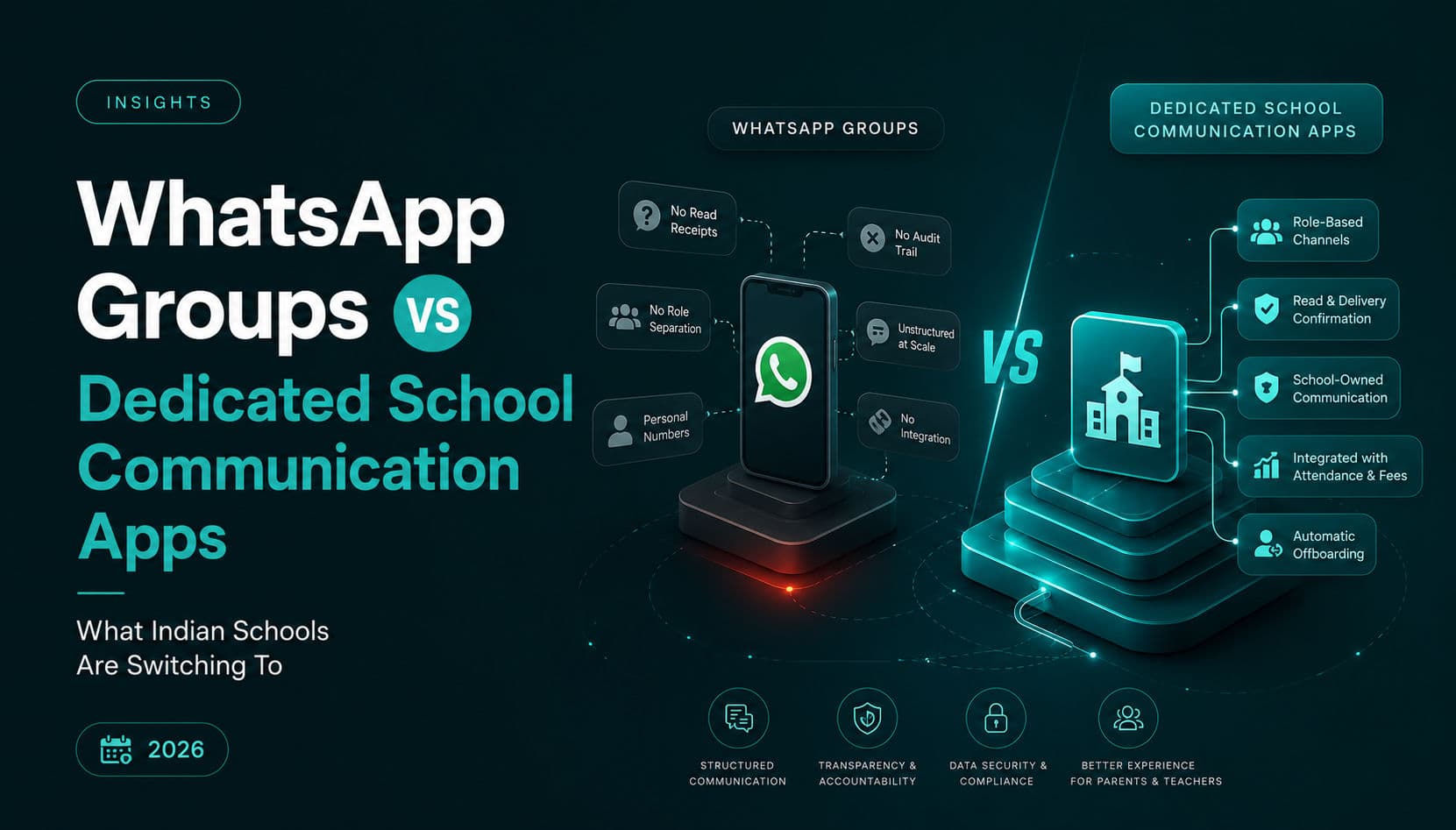
Walk into any school admin office in India, and you'll find the same setup: a dozen WhatsApp groups, one per class section, 40–60 parents each, a teacher trying to keep order, and a principal who has no real visibility into what's being said in any of them.
It worked when there was no alternative. It's breaking now that schools have grown past the size WhatsApp was ever meant to manage.
Why WhatsApp became the default
It wasn't really a decision — it was the path of least resistance. Every parent already had it installed, there was zero onboarding, and during the pandemic it was the fastest way to keep a class connected. None of that required IT support, a budget approval, or a vendor contract.
That convenience is exactly what makes it hard to walk away from. But convenience at setup and convenience at scale are two different problems.
Where WhatsApp groups actually break down
- No role separation — parents message teachers directly at 11 PM about homework, with no distinction between an urgent issue and a casual question
- No proof a notice was read — "seen by 30 of 50" isn't a record anyone can act on; there's no audit trail for a fee deadline or safety circular
- Personal numbers — teachers' messages from personal phones; when they leave, the conversation history leaves with them
- No structure at scale — past a certain size, the group is just noise: reply-alls, buried circulars, zero admin visibility
- No integration — attendance lives in one register, fees in another spreadsheet, and the group is its own island
- No offboarding — a student transfers or a teacher changes sections, and group membership never cleans itself up
None of this is a failure of WhatsApp as a product. It's a casual group-chat tool being asked to run institutional communication for a few hundred families — that's just not what it was built for.
What schools actually need instead
The schools making the switch aren't chasing more features — they're after structure WhatsApp can't offer:
- Role-based channels — broadcast-only for official notices, two-way only where a reply is genuinely expected
- Delivery and read confirmation — proof a fee deadline or safety alert reached every parent, not just "two ticks"
- Communication tied to the school, not the teacher's phone — message history stays put when staff changes
- One system connected to attendance and fees — a single view for parents instead of three disconnected ones
- Automatic offboarding — access ends the moment a student or staff member leaves
What it costs schools that don't switch
It's not just an inconvenience. It's missed fee deadlines that turn into awkward calls, parents who say "I never saw that notice" with no way to prove otherwise, and teachers losing evenings to messages that a structured system would have routed automatically.
For schools handling personal student data, there's a sharper edge to this, too: under the Digital Personal Data Protection Act, 2023, schools are data fiduciaries with real obligations around access control, consent, and breach intimation. An unstructured WhatsApp-based workflow — personal phones, no access logs, no consent trail — makes that compliance case considerably harder to demonstrate. We've covered this in more detail in our DPDP Act compliance guide for school software.
Making the switch without losing the parents
The biggest risk isn't the software — it's adoption. WhatsApp wins because everyone already has it; any replacement has to clear that bar. Schools that've switched successfully tend to do three things consistently:
- Keep notifications push-based and immediate, not buried in an inbox
- Migrate one grade or section first, not the whole school on day one
- Run both channels in parallel for two weeks before formally closing the WhatsApp groups
The schools still waiting usually aren't avoiding the switch out of preference — they're avoiding the one-time friction of change. But that friction is one-time. The WhatsApp group problem repeats every day that the school keeps using it.
HermesWorkspace was built around exactly this gap — structured, role-based communication tools for Indian schools, connected to attendance and the rest of the platform, without asking parents to learn a complicated new app. See how it works →